
[Analytic Investors] Roger Clarke, Harindra de Silva, and Steven Thorley
This paper, along with "Minimum Variance Portfolios in the US Equity Market", "Risk Parity, Maximum Diversification, and Minimum Variance: An analytic perspective", examine the empirical and analytic properties of minimal-risk equity portfolios, which is now a separate area of investment strategy called "low risk" or "managed risk", and the basis of several indexes indexes and ETFs, such as SPLV and USMV.
The reason we should care is that low relative returns to volatile stocks translates into high relative return to stable stocks. Volatile minus stable portfolios, or "VMS" portfolios to use a Fama/French style acronym, have negative returns. But turn the VMS factor on its head and that means positive returns against the market for carefully constructed portfolios. And even if those relatively higher returns are reduced by transaction costs and other implementation issues, returns that merely match the market with lower overall risk have a higher Sharpe ratio. A higher Sharpe ratio allows for larger equity exposures without violating risk budgets, or for explicit leveraging to market benchmark volatility and expected returns above the market. Yet another study showing how one could have beaten the market historically on a risk adjusted basis -- what's so novel about that? The collective data-mining efforts of academics and industry professionals over the past half century have produced more market anomalies than one can count.
What's so novel and interesting is that minimum-variance portfolios are a concept developed by Harry Markowitz in 1952, not in 2006. Nothing has been added to the mean-variance algorithm of his "Portfolio Selection" (1952) paper except the computing power and econometrics to apply what Markowitz prescribed to a large number of individual securities. Construct a minimum variance portfolio on the left-most tip of the efficient frontier back then, and you would have done very well indeed. No return forecasting, no CAPM, no reliance on what we have subsequently leaned about the factors that perform well --- just aim to minimize portfolio risk. We thought that was interesting enough to publish and study. 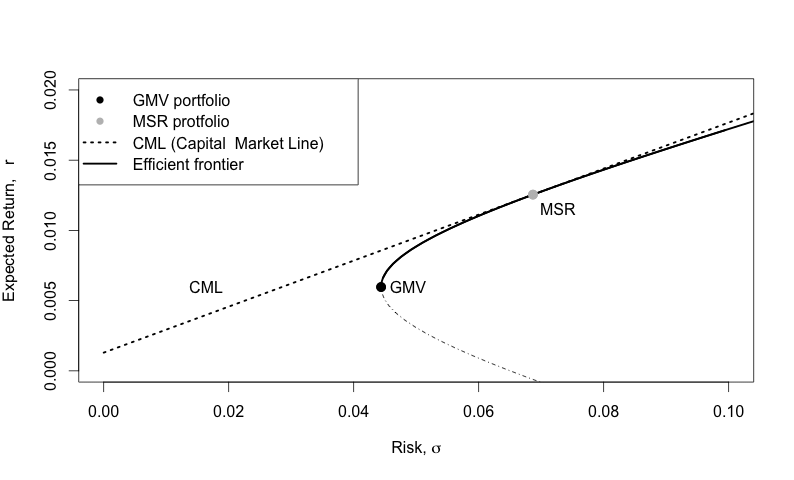
The unique contribution of "Minimum-Variance Portfolio Composition" is a simple and intuitive analytic solution for the individual security weights in a long-only minimum-variance portfolio. The formula shows that, while high idiosyncratic risk can lead to low security weights, securities with high systematic risk are completely taken out of the long-only solution. In fact, the relatively small set of securities that remain all have market betas below an analytically specified threshold beta. The analytic and empirical results of this study are part of an increasing awareness that the “low volatility” anomaly is a function of the long-standing empirical critique of the traditional CAPM; low-beta stocks have relatively high average returns.
In retrospect, what the institutional investing community now calls "low volatility" or "managed volatility" portfolio strategies were well timed for the financial crisis and other volatile regimes. We anticipate that low volatility portfolios will continue to have attractive properties in the years ahead. Results based on methodologies that are less dependent on researchers' collective data mining of the historical databases are arguably more reliable in the out-of-sample test.
We are still engaged in related research, further study documents that the returns to a pure beta factor in the US equity market and explain that the distinction between the market return and the return to the cross-sectional variation in security betas also applies to portfolio performance measurement. All would lead to the emergence of volatility as a market-wide equity factor comparable to size, value and momentum.