
Let’s start with a brief introduction on the author Merton Miller. Miller’ subtitle on the paper, “An eyewitness account”, suggests his role as an economist, but he was more than an eyewitness in the field of finance. Aside from his seminal work on “M&M proposition” in collaboration with Franco Modigliani in 1958, his generosity to other innovators of finance was boundless.
In 1959, Miller persuaded Modigliani to review an early draft of a paper by the then unknown economist Jack Treynor, in the very paper he laid out the basic principles of the capital asset pricing model (CAPM). In 1962, Miller introduced Myron Sholes to financial theory and recommend him in becoming a finance PhD at Chicago. In 1964, he encouraged the novice professor Eugene Fama to teach Harry Markowitz’s mean/variance theory when few people were taking any serious notice of this big-bang accomplishment. In the later years, Miller played a key role in promoting William Sharpe’s work on CAPM, Fischer Black and Myron Sholes’ option pricing model and other modern portfolio theory applications.
Miller’s paper begins with a fundamental decomposition that he believed was central for our understanding of finance: 1. Business school approach as “micro normative”; from this perspective finance deals with agents who are maximizing some objective function, taking the prices of securities as given. 2. Economic department approach as “macro normative”; which takes the world of micro optimizers as given and then proceeds to explore how the market prices evolve under those conditions. The interaction of these two streams of thoughts, Miller concluded, has largely governed the history of finance.
To illustrate his insights, Miller explains that Markowitz’s business school micro normative model of mean/variance theory. “The yield or return on an investment with the expected value of its possible outcomes… and its risk with the variance of those outcomes around the mean.” He points out that “The immediate contribution of that algebra is … the variance of a sum of random variables is the weighted sum of the variance plus twice the weighted sum of the covariance… Covariance, and not mere number of the securities held govern the risk-reducing benefits of diversification.”
Yet, Markowitz’s mean variance algorithm could be transformed into an economics department macro model called the CAPM. “Every investor should hold the ‘market portfolio’…with different risk aversion degree”. “CAPM implies the distribution of expected rates of return across all risky assets is a linear function of a single variable, namely each asset’s sensitivity to the market portfolio, the famous beta, which becomes naturally measure of a security’s risk.”
Miller then provides a fresh look at the EMH, in the course of which he comments on the failure of Nobel committee to give EMH the deserved attention (EMH did help Fama to win the Nobel Prize in 2013, hah). He believes that the connection between EMH and economics explains why the hypothesis has retained its vitality for so long: “Above normal profits, wherever they are found, inevitably carry with them the seeds of their own decay”.
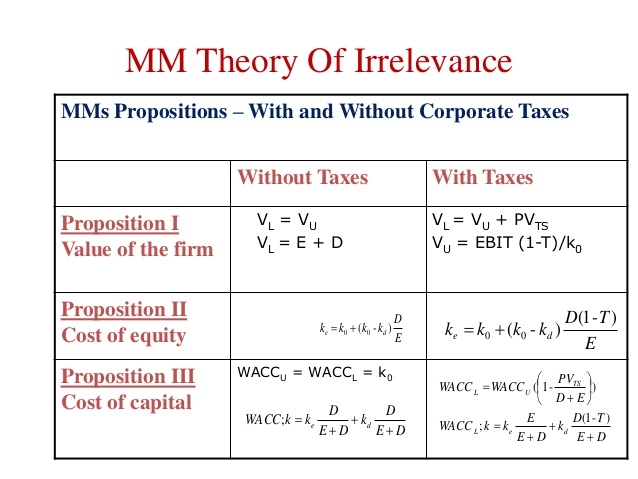 The discussion of the M&M propositions (also known as irrelevance of debt-equity structure theorem) is the longest part of the paper because “here, the tension between the micro normative and the macro normative approaches were evident from the outset”. “M&M propositions are also ways of saying that there is no free lunch. Firms cannot hope to gain by issuing low-cost debt rather than high-cost equity”. He emphasizes that the M&M propositions, like the EMH, are about equilibrium in the capital markets --- what it looks like and what forces are set in motion once it is disturbed.
When Miller comes to the options theory, he acknowledged that the achievements of the Black-Scholes-Merton will resolve the conflict between the two approaches to finance. The core dilemma of finance research is that the basic unit -- “the expected rate of return, was not actually observable”. Once the Black-Scholes-Merton option pricing model was in place, finance finally had its “observable” variable (the variance of the distribution of returns on the underlying share must be estimated, but estimating variances is orders of magnitude easier than estimating the means). This forms the basis of so many financial decisions and theory, a forward step whose significance cannot be overestimated
Merton concludes his essay with an answer to this question: “What would I specialize in if I were starting over and entering the field today?” And he answers, “I reduce my advice to a single word: options.” Options, in his view, will become the center of gravity in finance, resulting in a total reconstruction of the field as profound as Markowitz’s original breakthrough (the option pricing formula helps burgeoning a new specialty known as financial engineering, but I guess he didn’t foresee how it nearly destroy the Wall Street in 2008).