
Part I of why value factor failed recently and what have we neglected?
Book Value trap
It all starts from the complexity of valuing a firm’s assets in the digital age, but the result is that price-to-book is a less appealing guide to a stock’s true value now.
Price is the creature of fickle sentiment like greed and fear. Value, in contrast, depends on a firm’s capabilities. There are various shorthand measures for value, but both academia and practitioners put the greatest store by the price-to-book ratio. Since the seminal Fama-French three factor paper, countless study have shown buying stocks with low price-to-book is a winning strategy.
As the industrial age gives way to the digital age, value stocks have lagged a long way behind growth stocks. The key factor here is that the increasing intangible assets. The tangible world is easy, factories, machines, and office buildings count as capital assets on companies’ books. It is fairly straightforward to come up with a value for them – it is what the company paid, and this value is gradually written off over time to reflect wear and tear. Such fixed capital assets along with current assets (cash equivalent) typically make up the bulk of the book value.
Intangible assets are left out here. These days the value of a company lies as much in its reputation, its processes, the know-how of staff and customer-suppliers relationships as in tangible assets. Putting an accounting value on these intangibles is tricky. Not every dollar of R&D or advertising expenditure can be ascribed to a well-defined asset, such as a brand or patent. 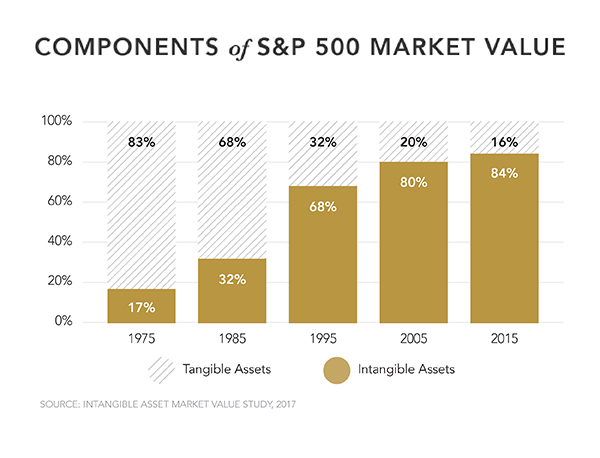 Intangible Asset increases in market value percentage
On the stock market, price is increasingly detached from book value. Plenty of well know companies (like FANG) – whose competitive edge rest on brands and patents – have much higher ratios or even negative book values. Yet these companies usually conducts routine buyback around earning seasons, which will rise the price-to-book value further. That is because for any company with a price-to-book ratio greater than one, buyback will diminish book value by proportionately more than it lowers the outstanding stock values.
The effects of mergers will only make things murkier. If, say one company pays 30 mil of tangible assets, the residual $70 mil is counted as intangible assets (usually as “goodwill”. As a result, a company has acquired brands by merger will have those reflected in its book value while a company has developed its own brands will not.
Forecast Earnings Dilemma
Imagine that investors could perfectly forecast the next quarters’ earnings for all companies. Then we construct a portfolio that long all the stocks that are expected to meet or beat the analysts’ forecasts consensus; while short the stocks that are supposed to fail the estimates. We start the trades two months before the quarter end and liquidate the positions one month after the quarter ends. This “perfect foresight” portfolio achieved excess return of 4+% every quarter in 1990s, but the abnormal returns dropped to 2% quarterly in recent years.
We argue that the decay of the strategy is due to the rising importance of intangible investments in recent decades. The financial statements have struggled to adapt to the modern business models. If a company purchase an intangible asset (such as a patent) from other companies, it is classified as an asset on the balance sheet. However if they develop an intangible within their own business, that is classified as an expense, and will be deducted from the profits. As a result, a company pursuing an innovation strategy based on acquisitions will appear more profitable than a similar company internally developing its innovations.
The outcome is – we argue – the reported earnings are no longer such a good measure of the company’s profitability, and thus not indicatable of future share performance. To test this proposition, we divided companies into five quintiles based on their intangible investment to re-run the previous “perfect foresight” strategy. Not surprisingly, the more companies spent on intangibles, the lower the excess return get harnessed by those who can correctly forecast the earnings. 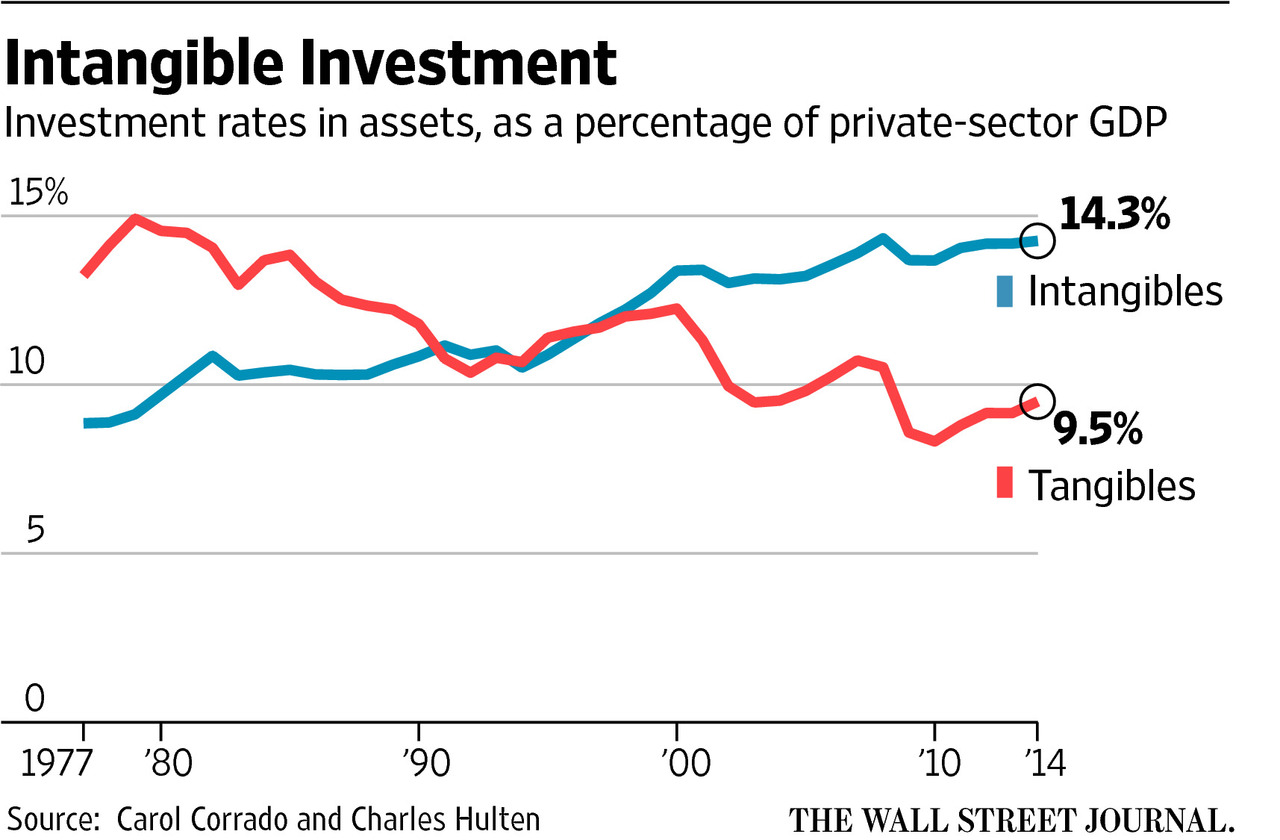 Increasing investment in intangibles
Yet the intangibles have spillovers. A company may undertake expensive R&D, but the gains may be realized by other businesses. Only a few companies (the industry leaders like Google) can achieve the scale needed to benefit from the sunken cost. Unlike machines and equipment, intangibles have unpredictable resale values. So the risk of failure will put most companies off intangible investments
The reluctance of many companies to invest in intangibles may restrict their growth scope in future. Investors looking for growth stocks will face a narrow choice and such companies will be so apparent to everyone that they will command a “seemingly too high” valuation. They are not seen as the value stocks, but they are the real “nifty fifty” (if not nifty five) stocks in the present.