
Part II of why value factor failed recently and what we could achieve?
In Eugene Fama and Ken French’s monumental paper, value factor premium is referred to as the HML(High Minus Low) Book-to-Market ratio. However the factor portfolio is constructed on annual basis, which incurs a huge information lag on the company valuation. Theoretically we could face a lag as long as 18 month; say on May 2019 right before the mid-year rebalance (the case when company delayed its financial statements releasing until last minute), we will still be using book value at the end of 2017. Modified the factor portfolio rebalance frequency can bring in immediate profit gain on the strategy, as pointed out by Assness and Frazzini in "The Devil in HML's Details". By refreshing the company Book value and its market value every month, the lag is constraint within one month and the strategy produce better performance. ![HML free fall in recent years] 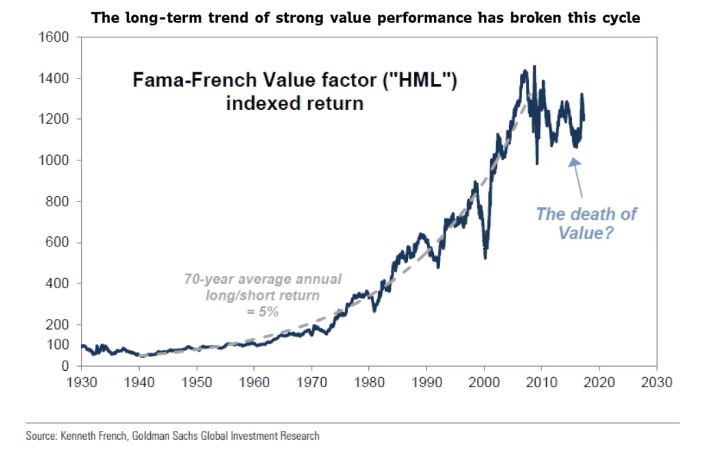 HML free fall in recent years
Value Forecasting
What if we take one step further? Raise the historical company valuation frequency could diminish the information lag, but how about predicting the company valuation in advance?
Analysts have long been forecasting company fundamentals using their fancy excel models, but they seem to be focusing the contemporary information along with their discretionary judgement. Academia proposed another approach of using historical figures along with neural network models to predict the look-ahead factors. In paper, the machine predicted ex-post factor yields better back-test results than their ex-ante peers. We could argue that, given more data points (such as historical company fundamentals from the company's supplier/customer) and we could achieve a more accurate prediction.
Book Value to Market Revisited
As we discussed in the last piece, " price-to-book is a less appealing guide to a stock's true value now ." Graham and Dodd arrived at the similar conclusion 80 years ago, " the book-value scorecard to become increasingly out of touch with economic reality. " Facing the tough situation, academia and practitioners proposed several workrounds on the BM factor.
Residual Income Valuation
Frankel and Lee (1998) decompose the company value into two components: book value and discounted value of future residual income. The current value of future residual income relates to the future ROE, future cost of equity capital, future dividend ratio and most importantly, the discounted rate. In a low interest rate environment, the future residual income will account more in company's valuation, book value alone is not deemed to estimate company value accurately.
R&D Capitalization
Technology sector and pharmaceutical sector are the main players in US market, one of their common traits is their enormous expense in research and development (R&D). They are willing to invest more than their gross profit on R&D, as long as it will benefit the company in the long run and harvest potential gain from being in the technical frontier. however, R&D expenditure was only viewed as costs in the book value (we covered similar topic in the last piece). Lev(2019) argues that capitalizing R&D (and SG&A) could help, adding back R&D and partial SG&A to book value justify companies' intangible investment.
Balance Sheet Restructuring
The very core formula for accounting is that total asset = total equity (book value) + total liabilities. total assets consists of financial assets and operating assets, and total liabilities likewise. Thus we could re-write book value = net operating assets - net financial liabilities. It reflects the fact that book value is both affected by company's operating risk and financial risk. Nevertheless, Richardson and Tuna (2007) states that future return is related more to the operating efficiency than financing activities, thus we should pay more attention to Net Operating Assets to Price ratio as a alternative to BM.
Retained Earnings
Ball (2019) gives out the secret source of Book Value: BV = Retained Earnings + Contributed Capital. Contributed Capital, which is essentially the net issuance, only indicates investors' risk appetite whilst less related with the company's future performance (think about the frequent share buybacks and re-issuance nowadays). Retained earnings, on the other hand, reflects accumulated net profit in the past, thus a better mirror for company's realistic profiting capability. Moreover if we are proxy retained earnings for book value, then BV becomes some sort of earning to price ratio, which links the stock return to company earnings (we all know PE ratio).